
Tuesday, June 26, 2018
We've moved!
The PigEasy website got a face-lift last fall and with it, our blog!
Visit https://pigeasy.com/blog/ for all new updates.

Tuesday, October 24, 2017
Top 5 MealMeter Questions Answered

Over the last few years, we’ve fielded a lot of questions on
the MealMeter feed dispenser. There are many I myself would
ask if I was in the customers’ shoes.
For those of you who are intrigued, but haven’t
caught up with us at a trade show or aren’t ready to make the call yet, here
are answers to the top five questions on the MealMeter feed dispenser.
1. What exactly is the MealMeter and how does it work?
 |
| MealMeter feed dispenser |
The MealMeter is a feed dispensing device that is latched
(more on that later) in a drop feed tube in the breeding area of a sow farm. It
was developed to convert the feed tube into an ad-lib feeder.
Ad-lib feeding is popular in lactation because it is known
to optimize feed intake at a time when sows need to consume a lot of feed in
order to milk a healthy litter and not lose condition to be ready for her next
cycle. However, little was done before the MealMeter to improve feed intake for
pre-breed gilts, weaned sows and under conditioned sows in the breeding area
even though feed intake is very important at this time in her reproductive
cycle.
The MealMeter allows these sows the extra time needed to
consume their daily ration. Just like in the finishing barn, some sows are
“snackers” and some sows are “gorgers”. By giving her the freedom to choose
when and how much to eat, she’s able to maximize feed intake so she is in prime
condition to have another productive litter.
 |
| MealMeter with Breeder Bowl |
The breeding area of the sow farm is where you can typically
expect a lot of wasted feed because it’s where we all try to push the limit of
feed consumption, but not in the way she needs it. Dropping a large amount of
feed to her one or two times a day is labor intensive because you’re going to
end up cleaning a lot of it out later when it becomes stale or rotten. Hand
feeding is labor intensive because staff is hand scooping their estimate of
what she is going to eat in each stall multiple times a day in order to drive
feed intake yet attempt to lower waste.
The MealMeter takes the human element out of feeding sows.
It saves on feed waste while at the same time pushes intake.


There are a couple different ways to set up the MealMeter in
the breed row. We’ll dig deeper into these two options later. In the meantime,
here’s a comparison between the two. Feel free to call (888) 354-0112 with any
questions.
 |
| MealMeter in PigEasy Sow Feeder |
The MealMeter is also offered in farrowing where it is
inserted into an accompanying product, called the Lactation Boot, and installed
onto the sow feeder. To optimize feed intake, we suggest using the PigEasy Sow
Feeder, but the MealMeter and Lactation Boot can be retrofitted onto most
existing feeders, along with the lactation water bracket.
The key to feeding sows in lactation with the MealMeter
system is the water pipe in the feed bowl. The button nipple at the bottom of
the water pipe requires the sow to “self-regulate” the feed flow into the sow
feeder. Every time the sow goes in for a drink, she is cleaning up her eating
area so it is ready for her next meal.
2. Isn’t the sow just going to play with it?
This is probably the most popular question we’re asked about
the MealMeter. I believe it’s because of producers’ previous experiences with
ad-lib feeders where they see sows continue to fill up their bowl and never
fully clean it out.
Is the sow playing with the feed? In our experience, not
exactly.
Before I explain how the MealMeter is set up to not allow
the buildup of feed, I’m going to first explain the issue with ad-lib feeders
in general and feed build up.
We’ve observed many sows consume feed with different feeders
and we’ve come to the conclusion they aren’t playing. They’re layering.


With ad-lib feeders, sows are dispensing the feed, eating a
little bit, then heading back up for the fresh stuff without ever cleaning up
what they originally dispensed. That’s where you get this layering effect and a
bowl full of half eaten feed.
In breeding, the MealMeter’s set up options combat the
layering issue in two different ways.
 The traditional set up has the MealMeter drop feed into a
dry trough. Sows are watered via the SnoutSpout nipple bracket installed on the
divider. The custom built feed tube has a viewing window toward the front
aisle, so as the staff walks the row throughout the day, they can set the boxes
to either push intake or hold back depending on the amount dispensed. Like Dad
says, “You can either take seconds managing feed at the feed box or on your
knees cleaning out the wasted feed that day.” With the MealMeter, feed is staying fresh in the tube until the sow is ready to eat. The traditional set up is where
we got our start with the MealMeter and led Klocke Farms to a 1.75 total born
increase with P1 sows.
The traditional set up has the MealMeter drop feed into a
dry trough. Sows are watered via the SnoutSpout nipple bracket installed on the
divider. The custom built feed tube has a viewing window toward the front
aisle, so as the staff walks the row throughout the day, they can set the boxes
to either push intake or hold back depending on the amount dispensed. Like Dad
says, “You can either take seconds managing feed at the feed box or on your
knees cleaning out the wasted feed that day.” With the MealMeter, feed is staying fresh in the tube until the sow is ready to eat. The traditional set up is where
we got our start with the MealMeter and led Klocke Farms to a 1.75 total born
increase with P1 sows.
We knew we could do more though. After coming to understand
the layering effect and setting up the sow feeder in farrowing to “self-regulate” with the
water pipe, we wanted to mirror that success in the breed row. So, we developed
the Breeder Bowl.
 |
| MealMeter with Breeder Bowl |
The Breeder Bowl can be mounted on both straight front and sloped
front stalls. This eliminates the need for a trough. Existing troughs do not
pose a problem as the Breeder Bowl can be installed above the trough with
enough clearance to open the gate. The Breeder Bowl is small enough to not lose
any boar exposure and will not protrude into her stall space.
This new set up provides sows the freedom to choose when she
wants to consume her feed with little to no daily management.
3. How much feed does the sow dispense at a time?
 |
| MealMeter Chambers (also part called the Elevator) |
I have to begin with a disclaimer that the answer depends on
your feed type and density. However, we’ve measured our own feed to get a
general estimate.
There are four moving chambers inside the MealMeter. As the
sow spins the MealMeter nose, the chambers are filled and the feed is dispensed
from the top opening of the MealMeter body.
Each of these chambers holds roughly 1/3 oz. Therefore, the sow will
dispense 1lb of feed with 12 complete spins.
Watch this video of the MealMeter in the breed row. You’ll
see the sow spins the MealMeter 2-4 times before actually eating. She eats for
a little bit, then heads back up for another 2-4 spins.
We’ve found the amount the the MealMeter drops to be a sweet
spot as it’s enough to satisfy her so she doesn’t get frustrated and not too
much that she inadvertently over-dispenses.
Another question we get asked that usually follows #3 is “How
much does a feed tube hold?” We custom manufacture 3 inch OD stainless steel
feed tubes for the MealMeter and can estimate that each foot of 3” OD tube
holds 1.65lbs.
4. How is the MealMeter removable?

The MealMeter has a latch on the top of the body and is
latched onto the stud that is installed at the top side near the opening of the
custom feed tube and the Lactation Boot.
 To install or remove, stick a pliers handle or
screwdriver into the dispensing hole of the MealMeter body. This controls and
locks all the pieces together so you can successfully latch the MealMeter onto
the stud. Inserting it into the tube, turn the MealMeter toward the
latch. You’ll feel and hear a click to know it was successfully latched.
Removing is exactly the opposite. After sticking the pliers handle into the
MealMeter dispensing hole, you’ll turn opposite the way it was latched in until
you feel/hear a click and then pull out.
To install or remove, stick a pliers handle or
screwdriver into the dispensing hole of the MealMeter body. This controls and
locks all the pieces together so you can successfully latch the MealMeter onto
the stud. Inserting it into the tube, turn the MealMeter toward the
latch. You’ll feel and hear a click to know it was successfully latched.
Removing is exactly the opposite. After sticking the pliers handle into the
MealMeter dispensing hole, you’ll turn opposite the way it was latched in until
you feel/hear a click and then pull out. You can install the MealMeter on either side of the stud,
but we suggest you turn the MealMeter away from the sow to install. The sow
typically turns the MealMeter up (imagine a sow’s natural rooting movement) and
you want the sow to turn the MealMeter into the stud. If it’s installed the
opposite way, not to worry. The sow shouldn’t be able to get the MealMeter out
because she only has access to the MealMeter’s nose.
You can install the MealMeter on either side of the stud,
but we suggest you turn the MealMeter away from the sow to install. The sow
typically turns the MealMeter up (imagine a sow’s natural rooting movement) and
you want the sow to turn the MealMeter into the stud. If it’s installed the
opposite way, not to worry. The sow shouldn’t be able to get the MealMeter out
because she only has access to the MealMeter’s nose.
5. What if a MealMeter
piece breaks?
Sows tend to be a little hard on equipment, so we completely
understand why this is a top question. Taking that into consideration, we made
the MealMeter into four separate parts that are easily replaceable.
 |
| MealMeter Parts |
There are two options to the the MealMeter nose, plastic or stainless steel. Most people choose the stainless steel option, but there are certain situations where plastic is most beneficial. Klocke Farms uses mostly plastic MealMeters. The nose is attached to a stainless steel
square shaft that holds the rest of the pieces. The chamber or elevator is assembled
inside the MealMeter body. The agitator or tail is installed on the back side
of that shaft. Everything is held together with a stainless steel roll pin.
Let’s pretend a rock comes through the feed line and busts
the MealMeter’s agitator. (I mean, you’ve only HEARD of things like that
happening, right? Us too. 😉)
You need a new agitator to keep the feed flowing, so you
give me a call, we send you out a replacement piece and a roll pin punch. You
simply punch out the roll pin, replace the agitator, put the roll pin back in
and you’re back in business.
The same goes for all of the other MealMeter parts. If you’re
having issues with a certain part of the MealMeter, there’s no need to replace
the entire thing. We can supply you with replacement parts and it takes little
effort to fix.
__
Our goal when developing the MealMeter was to make it easy
to use and manage and that’s not just because our name is PigEasy; it’s because
we’re pork producers too and understand what’s important to you.
If any of your top MealMeter questions weren’t answered,
send me an email (Katie@pigeasy.com) or
give me a call (888) 354-0112. I’ve got more information up my sleeve and would
be happy to help!
Until next time,
Katie
Friday, September 29, 2017
Reproduction is a Luxury

A consulting veterinarian we’ve utilized for years at Klocke
Farms has the heart of a teacher. He likes to stay focused on the fundamentals
and uses phrases that stick in your head long after he heads back to the office.
We often catch ourselves repeating these one-liners when we talk about the
MealMeter feed dispenser. Yes, he’s a good teacher.
We were reminded of one of them recently that sums up the
importance of feed intake at key points in a sow’s reproductive cycle.
“Reproduction is a luxury.”
Basically, a sow’s primary physiological goal is to keep
herself alive. Only when her needs are met and she is in the right body
condition is her body able to successfully reproduce. Therefore, reproduction
is a secondary goal, or a luxury.

A sow enters into a catabolic state when she begins
lactation. This means that if she’s not consuming enough calories, she will
rapidly burn through her fat stores. Losing condition quickly in lactation
increases the sow’s likelihood of prematurely leaving the herd due to
reproductive failure. Because her body’s primary objective is survival, her
body’s energy is going to be solely focused on building back those fat stores.
However, our consulting vet points out that even in the best
of conditions, a sow is still in a catabolic state in lactation. No matter how
much she eats, she’s still burning fat. And if she drops off feed post wean,
her body could still be burning those fat stores for 2-4 more days.
 Jumping species, he recently told us about this Holstein in Wisconsin that broke the record for gallons of milk produced in a year. He said
even with this cow in the best of conditions and eating top notch feed, she
still ended up losing 300 lbs.
Jumping species, he recently told us about this Holstein in Wisconsin that broke the record for gallons of milk produced in a year. He said
even with this cow in the best of conditions and eating top notch feed, she
still ended up losing 300 lbs.
We all think sows can make up for it throughout gestation,
but research indicates that the best shot for a sow to rebound is in the first trimester.
This is why feed intake post wean is imperative to the sow’s
reproductive success. A sow can rapidly rebound post wean in the right
conditions and when given a chance. As pork producers, it is our job to ensure all
of the sow’s needs are met before we can expect her to produce and milk large
litters.
We hear from consultants and experts across the industry
that we need to feed as much as we can to newly weaned sows. And we all try.
Unfortunately, what you end up with is a bunch of feed to clean up.

That’s why we developed the MealMeter. The MealMeter for
weaned sows serves as a transition from lactation to the gestation barn. It
gives each sow TIME needed for her to eat fresh feed when she’s ready for it
without the waste associated with feeding weaned sows. If she’s ready to eat at
10:00 at night, feed remains fresh in the tube ready for that moment. In a
typical setting, her feed would either be washed down to her neighbor or remain
stale and eventually build up into a mess.
Farms using the MealMeter see improvement in feed intake,
and the benefits of that are widespread. At Klocke Farms, we observed an
improvement in overall sow herd condition and that translated into higher sow
longevity and a huge increase in pigs per sow per lifetime. PigEasy customers are noticing are getting similar results as they have greatly improved feed intake while at the same time reducing feed and water waste.
Reproduction is a luxury so it is important to make sure she
is in a condition that allows for a successful subsequent litter. The MealMeter
can help you accomplish that. Visit www.pigeasy.com
or call (888) 354-0112 to learn more.
Until next time,
Katie
*** We have a new set up option for the MealMeter in breeding called the breeder bowl. For more information, call (888) 354-0112 or email Katie (katie@pigeasy.com).
*** We have a new set up option for the MealMeter in breeding called the breeder bowl. For more information, call (888) 354-0112 or email Katie (katie@pigeasy.com).
Tuesday, August 22, 2017
The Ingenuity of Pork Producers

Call it inventive, resourceful, creative or just plain
desperate (I’m kind of kidding…); pork producers have the most interesting
tricks hidden up high in those coverall sleeves of theirs. Spending time at
industry trade shows and conferences, I’ve heard a lot about different
contraptions producers have rigged up to make any job a little easier. It
always impresses me. I may be biased, but pork producers come up with some great
ideas to simplify tasks and improve their operation’s efficiency.
Oftentimes they don’t realize their own cleverness until
someone else makes a note of it. Take my dad, for instance. Most of the PigEasy
products were developed with only our farm in mind and weren’t put on the
market until an outside consultant noticed it on a walk through and mentioned
to him that it would be beneficial for other farms to use.

Today’s trick isn’t some new and exciting product we’ve spent years developing, but it gives an example of how a little handiness can make a huge difference in streamlining daily tasks.
 When we began AI-ing sows over 20 years ago, Dad wanted to
keep the AI supplies organized and in one spot. He didn’t want that spot to be
in the way and also didn’t want it to slow down the process by keeping it stationary.
After noticing the top of the g-stalls were connected via two rods, Dad decided
to make up a tray that could use the rods as a track.
When we began AI-ing sows over 20 years ago, Dad wanted to
keep the AI supplies organized and in one spot. He didn’t want that spot to be
in the way and also didn’t want it to slow down the process by keeping it stationary.
After noticing the top of the g-stalls were connected via two rods, Dad decided
to make up a tray that could use the rods as a track.
The roller tray is made from a light angle iron and
1/4" thick plastic sheet. He bought small lawn mower wheels, cut off the
rubber and installed them on a 1/2” rod.
Some simple cutting and welding is all it took to make the
roller tray and it has helped speed up and simplify AI-ing sows at KFI. We
still use the originals today.
 As a pork producer, you have a never-ending list of tasks
and any tool that makes your day easier is well worth the upfront time it takes
to put it together.
As a pork producer, you have a never-ending list of tasks
and any tool that makes your day easier is well worth the upfront time it takes
to put it together.
That’s why we’re called PigEASY. We believe simplifying
daily chores can make a huge impact on the success of your sow farm.
Until next time,
Katie
Tuesday, July 11, 2017
Tuesday’s Trick of the Trade: Ear Tagging

KFI began a new program some time ago that required all pigs
to be tagged on both ears Day 1-2. We quickly got set up to tag hundreds of
pigs a day; everything seemed straightforward and efficient. That was until we
observed the toll it took on our staff. Our KFI crew was burning out rapidly
and who could blame them? They were squeezing the tagger on both ears of
hundreds of wiggling pigs while hunched over holding them in place. Whew!
That’s a lot to ask someone to do day in and day out.
Dave knew he had to figure out a solution when his employees
began to dread the task at hand. He had to #1: eliminate the repetitive
squeezing, #2: somehow find a way to more efficiently organize all the tags
before they are applied to the pigs, and #3: speed up the process.

With collaboration, the PigEasy ID Cart was developed. It
wasn’t surprising the benefits of using the ID Cart blossomed after using the
first prototype. Because maybe you’re like me and prefer to read fast, I
compiled a list of the Top Benefits of the PigEasy ID Cart:
1) Saves your Hands and Back
 To tag pigs with the PigEasy ID Cart, the operator standing
upright, simply holds the pig in one hand, positions the ear with the other and
steps on the pedal that applies the tagger. That’s it. This means no more
squeezing and no more crouching to tag pigs. Not only do you save your hands
and back from the complications of the repetitive, strenuous task, but you also
get rid of the typical fatigue that shows up quickly into this daily chore.
To tag pigs with the PigEasy ID Cart, the operator standing
upright, simply holds the pig in one hand, positions the ear with the other and
steps on the pedal that applies the tagger. That’s it. This means no more
squeezing and no more crouching to tag pigs. Not only do you save your hands
and back from the complications of the repetitive, strenuous task, but you also
get rid of the typical fatigue that shows up quickly into this daily chore.
What this means for you if you’re a
Sow Farm Employee:
You save your body from the arduous job of tagging and are able to be
more effective in this task and throughout your shift each day.
Sow Farm Manager/Owner:
You increase efficiency, employee morale and retention while lowering
risk of workmen’s comp issues in the future. (3 Words: Carpal Tunnel Syndrome)
2) Speeds Up the Process
The PigEasy ID Cart is set up as a two person job, so someone is always loading the taggers and the other is holding the pig and operating the foot pedals. With everything set up, in place and in close proximity, you can quickly tag a lot of pigs.
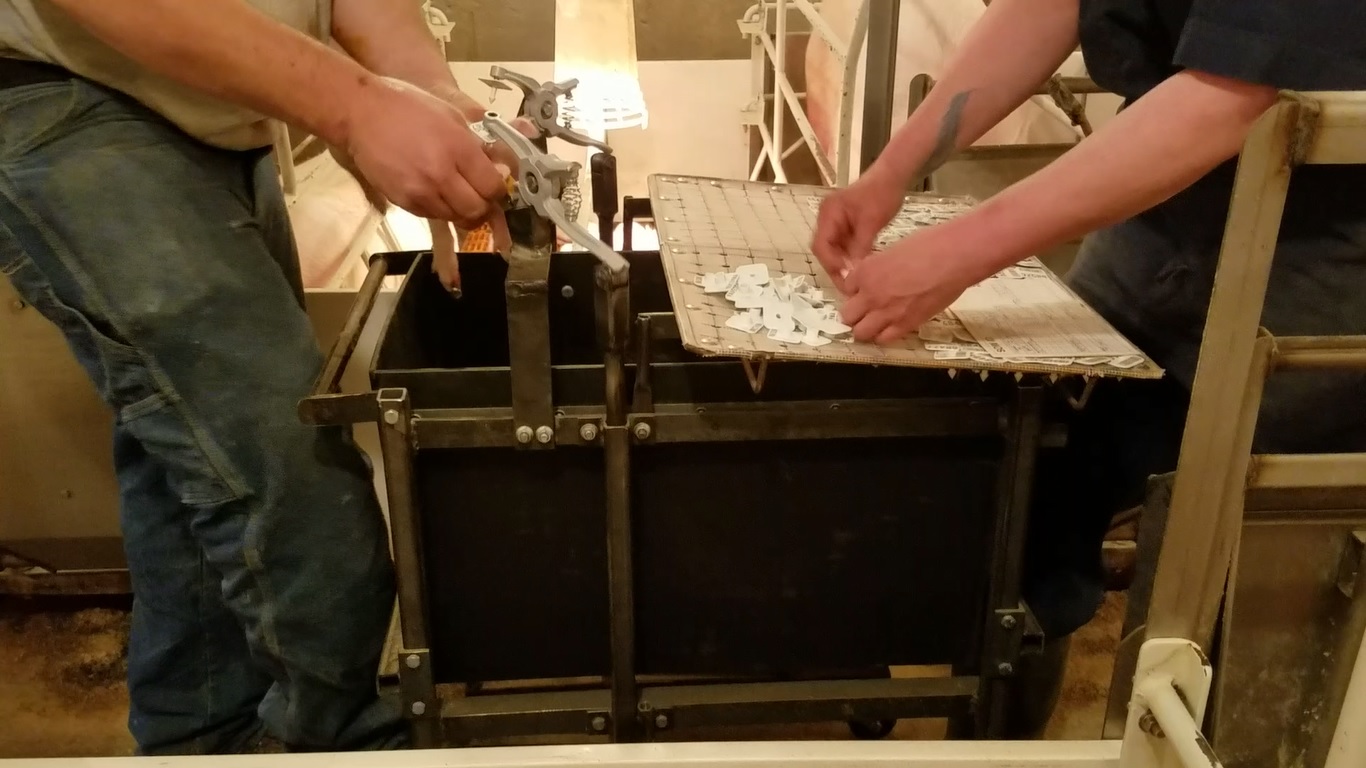
Tags are set up on the sheets prior to heading out to the
farrowing barn so organizing is done before the task begins. This makes for a
quick turnaround.
With everything operating smoothly and
efficiently without fatigue, the KFI crew can tag a litter in about 2 minutes. (This
is from the time they arrive to load the pigs in the cart, to finishing up the
paperwork after all the pigs are tagged!)
3) More Uniform Application
 Now, I understand that “fast” isn’t always better. But
because the PigEasy ID Cart is operated by two foot pedals, the person tagging
can use both hands to hold the pig and ear in place. It’s a lot easier to get the
placement of the tag right when you’re not handling the tagger and the pig at
the same time.
Now, I understand that “fast” isn’t always better. But
because the PigEasy ID Cart is operated by two foot pedals, the person tagging
can use both hands to hold the pig and ear in place. It’s a lot easier to get the
placement of the tag right when you’re not handling the tagger and the pig at
the same time.
This leads to an increase in tag retention later in the wean
to finish stage.
4) Increased Organization and Efficiency
 |
| One of the first prototypes on the farm |
By having all the tags ready on the tagging sheet before you
head out to the barns, you’ll have the tags already organized before things get
hectic in the room. The tagging sheet is also designed so the tags won’t fall
out if you were to drop it.
Speaking of the tagging sheet, there are trays underneath
the hopper for 3 additional trays so you do not have to head back to the office
when you empty one. If you tag by color, you can organize each tray to a
different color and have it close by for simple switching.
Its holding hopper specifically designed for the cart is
large enough for a full litter and deep enough so they can’t jump out.
The PigEasy ID Cart tags pigs quickly, accurately, and with
a lot less effort compared to manual tagging. Take a look at this video to
watch the KFI crew tagging in action:
If you have similar problems with tattooing, no problem! We
can easily convert the ID Cart to accommodate tattooing.
Call (888) 354-0112 for pricing and details.
Until next time,
Katie
Wednesday, May 24, 2017
Pork Producer Intuition turns Innovation
 |
| World Pork Expo, Des Moines, IA |
The 2017 World Pork Expo is around the corner and we’re
putting the finishing touches on PigEasy products that will be featured in our
expanding booth (#V729). Even as we focus on promoting our tried and true
product line, Dave never stops developing new innovations.
The tough decision every May is “What do we put in our booth
this year?”
1. MealMeter feed dispenser -
 |
| Stainless Steel MealMeter |
No question about it, we’ll have the MealMeter set up in a g-stall display. The MealMeter is what launched PigEasy and we are proud of how it boosts feed intake while preventing waste with incoming gilts, weaned sows and under conditioned sows.
 |
| PigEasy Sow Feeder |
2. PigEasy Sow Feeder -
The MealMeter will also be installed in the PigEasy Sow Feeder. The sow feeder’s one-of-a-kind design eliminates feed waste. (Yes, it really does!) By removing the corners, making this her only water source and using the MealMeter as the ad lib feed dispenser, you will get rid of the tedious task of cleaning out feeders.
 |
| PigEasy Farrowing Crate |
3. PigEasy Farrowing Crate -
The PigEasy Sow Feeder will be displayed with the PigEasy
Farrowing Crate. Simple design with exclusive features, the PigEasy Farrowing
Crate is built with durability, ease of use, and sow comfort in mind. (Remember
the Flip Over feature?) Stop by our booth (#V729) to check out the one crate
that makes sow care a whole lot easier.
We’re launching a number of new products this year. Some
continue to focus on feeding because we know ourselves how feed is one of the
biggest expenses on the farm and is always an area of improvement at every
stage.
4. Breeder Bowl -
 |
| PigEasy Breeder Bowl |
Speaking of PigEasy Sow Feeder, we’ve also wanted to allocate the success of the PigEasy Sow Feeder over to the breed row. To have the same feeding system in the breed row that’s also in farrowing makes the transition seamless and avoids any reproductive hiccups in the future. To mirror the inner workings of the Sow Feeder, we’ve developed the PigEasy Breeder Bowl. The Breeder Bowl benefits from the same bottom design as the Sow Feeder without interfering with her access to boar exposure during breeding. Like the Sow Feeder, the Breeder Bowl serves as both her feed and water source, which regulates over-dispensing and over-watering and is self-cleaning. If you’re wanting to take feed intake to the next level pre-breed, you need to check out the MealMeter with the Breeder Bowl set up.
5. PigEasy I.D. Cart
 |
| PigEasy ID Cart |
Finally, we’ve branched out from feeders and tackled another major migraine on a sow farm; pig tagging. Certain programs require ear tagging all pigs farrowed on a sow farm and it becomes a time-consuming, fatigue-inducing chore. Ear tagging hundreds of pigs a day takes a huge toll on staff and can add stress to your hands and back. Klocke Farms employees were wearing down after starting a new program that required ear tagging, so Dave got to work. With help, he invented the PigEasy ID Cart. The PigEasy ID Cart is a foot operated double tagger that also serves as a holding cart for the litter. The PigEasy ID Cart also comes with a tagging sheet to organize your tags. I can’t even come close to being able to describe how cool this cart is. Check out this video to watch how quickly the team can tag pigs accurately and with much less effort. We’ll have one of these at the show as well, so you can test it out for yourself at the PigEasy Booth (#V729).
We’re looking forward to another wonderful year at the World
Pork Expo June 7-9 at the Iowa State Fairgrounds!

See you then!
Katie
Thursday, April 27, 2017
Strengthening your Weakest Link
"You’re only as strong as your weakest player."

We’ve heard this line from our coaches throughout our childhood. Maybe you were the star athlete who mentored
teammates that could use some improvement after you heard these words of wisdom.
Or maybe you were the kid who immediately thought, “Crap! Is that me?”
(guilty!) and spent the rest of the season paranoid you’re bringing down the
team.
 Regardless of where you were on the spectrum, this statement
carries much truth. If you have a weak
center fielder, experienced players at bat are going to try to hit it to them
EVERY TIME.
Regardless of where you were on the spectrum, this statement
carries much truth. If you have a weak
center fielder, experienced players at bat are going to try to hit it to them
EVERY TIME.
The prime intention for signing kids up for sports isn’t to
create star athletes who go on to make millions in the big leagues. Our kids are part of the team to learn invaluable life lessons about working together toward a common
goal.
As sow farm operators, our common goal is to keep sows
healthy and productive throughout their life so they farrow healthy and
productive pigs for market. I would say we’re succeeding as an industry with
increased numbers of pigs out the door every year.
All too often though, our focus on the number of pigs out
the door overpowers our focus on sow longevity. This can be a costly mistake.
 Regardless of farm size, if you had the ability to change
the outcome of just a handful of young sows each week in farrowing or pre
breed, the affects could very well transform your herd.
Regardless of farm size, if you had the ability to change
the outcome of just a handful of young sows each week in farrowing or pre
breed, the affects could very well transform your herd.
The “weakest” sows, typically lower parity sows that lose
condition in farrowing, often get moved back to breeding with the idea that she
will regain condition over the course of gestation. Unfortunately, studies
indicate otherwise.
“Anil et al., (2006) reported that sows consuming ≤
3.5 kg (7.7 lb) of feed per day during the first two weeks of lactation were
more likely to be removed from the herd before their next parity. The odds of
removal were highest for sows that did not consume any feed during any single
day for the first 14 days of lactation. The bottom line from this study is “if
the sows don’t eat in lactation, they are going to leave the farm.”” - Managingsows for optimum retention by Zach Rambo, Dr. Jerry Torrison, Mark E. Wilson
 If there was a solution that could change the outcome of
five lower parity sows a turn in addition to raising the bar on the high
performing sows, how much would you save a year in replacement costs? Five sows
doesn’t sound like much, but similar to compound interest, the returns keep
building. Let’s say you made a change that resulted in saving 5 P1s and P2s
each turn of a group. If you’re weaning a group each week, five sows saved per group turn would equal out to around 260 productive younger sows remaining in the
herd each year. That’s 260 less replacement gilts to purchase and acclimate to
the farm, not to mention 260 better performing animals taking up space.
If there was a solution that could change the outcome of
five lower parity sows a turn in addition to raising the bar on the high
performing sows, how much would you save a year in replacement costs? Five sows
doesn’t sound like much, but similar to compound interest, the returns keep
building. Let’s say you made a change that resulted in saving 5 P1s and P2s
each turn of a group. If you’re weaning a group each week, five sows saved per group turn would equal out to around 260 productive younger sows remaining in the
herd each year. That’s 260 less replacement gilts to purchase and acclimate to
the farm, not to mention 260 better performing animals taking up space.
We learned these effects are long term at Klocke Farms. By
focusing on ad lib feeding at key points in a sow’s reproductive cycle (prebreed and in lactation), sows choose to consume their daily ration at their own
time throughout the day instead of when we decide. By giving sows the choice,
limited intake days are avoided and sows stay in great condition and remain productive
in the herd.

Initially, we observed a huge jump in Total Born with P1
gilts and over time lowered our replacement rate because our Pigs per Sow
Lifetime continues to increase. Saving those bottom tier sows changed the
entire makeup of our sow herd. Not only do we get more out of each gilt
investment, but the herd is healthier and much more uniform overall.
Just like our coaches drilled into us when we were kids, the
weak players on a team affect the team’s overall success more than we all think
and by bringing that lower tier up, it boosts the team up all around. I guess
we can chalk another one up for our childhood coaches!
Until Next Time,
Katie
Tuesday, March 21, 2017
A New AI Saddle Option

With the AI Saddle, we’ve been living under the age-old
advice of “If it’s not broke, don’t fix it.” And who can blame us? This
artificial insemination tool has been a gold standard in the swine industry for
almost 15 years with major improvements in 2006. Producing a top notch,
dependable product has been our criterion and making any sort of change could
upset the apple cart…. or so we thought.
Pork Producers love the AI Saddle because:

1) It speeds up breeding time. That’s the number one
 2) Its snug fit helps with stimulation and keeps the saddle
in place along with the semen bag/bottle. Speaking of…
2) Its snug fit helps with stimulation and keeps the saddle
in place along with the semen bag/bottle. Speaking of…
3) The heavy duty belt with Velcro secures both bags and bottles
at an upright angle to ensure complete emptying.
4) The AI Saddle is extremely durable and long lasting. We
continue to use many of the original 2006 injection molded plastic saddles at
Klocke Farms. They still work like a charm!
However, we have been challenged with a few requests from
customers that all led to another saddle option. The requests were:
1) “We want to be
able to put on the saddle with one hand.”
Breeding technicians are multi-tasking throughout the task
of breeding because everything needs to work like clockwork. Therefore, many
breeding technicians would like to be able to place it on the sow with one hand
while holding the AI supplies in the other.
2) “We have older
sows in the herd that are pretty large and worry about the saddle being too
tight.”
As genetics, nutrition and feeding systems continue to
improve, we have the ability to keep productive sows in the herd much longer,
which also means that they can get substantially larger. Basically, there can
be quite a range in weight and size between sows in the same herd.
So, we got to work.
We developed a new width with the same effective design to tackle these
requests. After testing it out in our
breed barn (what we do with all our prototypes), we knew we had the answer; the
Husky Saddle.
 |
| The Husky Saddle will feature gray colored plastic to differentiate from the AI Saddle |
The Husky Saddle has a wider opening that can be applied and
removed with one hand. The wider opening also fits easier on larger sows, while
continuing to be a snug fit that doesn’t fall off if the sow rubs up against
the divider. It is made of the same plastic and same general design of the AI
Saddle so we know it is just as effective and durable. It features the same heavy
duty belt to hold up any type of semen apparatus. Basically, you will continue
to have the reliability of the AI Saddle, yet built for the more mature gals.

For those of you who love the AI Saddle as is, not to worry!
The regular AI Saddle will still be available in addition to the new Husky
Saddle option.
Because there are sows of all ages on your farm, you may
want both saddles available at breed time. OR maybe you will prefer one over
the other, depending on your type of genetics and herd. Either way, you have
two reliable options to best fit your AI needs.
 |
| AI Saddle (white) vs Husky Saddle (gray) |
Call (888) 354-0112 or email info@pigeasy.com to find out
how to order.
Friday, February 24, 2017
Conquering the Pain of a Production Migraine
I started getting migraines in middle school.
 |
| I left most softball games with a bad migraine from getting overheated. |
“Yep.”
I was so
used to the throbbing pain and nausea that I could function like a normal human
being and while people knew I suffered from migraines, no one realized the
extent of it.
As I matured, I learned some of what set them off and tricks
to lessen the blow, but they were still there.
 |
| This little guy was a blessing in more ways than one. |
Now when I get a migraine, they are KILLER. I need a dark
room, an ice pack, and some time to get over it. Is it that these migraines are
worse than before? Has my pain tolerance gone down? I don’t think so.
I believe I was so used to being in semi-constant pain that
it was a continuous reality of mine and I just lived with it. Because what was
the alternative?
How often do we have “migraines” in our lives that we just
live with? They are constant, throbbing problems that bring huge hiccups to our
business and its success, but 1) we can’t find the trigger, and 2) even if we
found the trigger, a solution isn’t readily available.
 Feeding sows was a migraine for my dad. We knew how
important optimal feed intake was, but we couldn’t get it right. We set the
boxes too high, there was too much feed waste; we set the boxes too low,
production suffered.
Feeding sows was a migraine for my dad. We knew how
important optimal feed intake was, but we couldn’t get it right. We set the
boxes too high, there was too much feed waste; we set the boxes too low,
production suffered.
We hear about it a lot with other producers. Everyone knows
it’s a problem. Each farm does what it has to do to get feed into these
animals, but at what cost? The cost might be pretty clear, as in excess feed waste.
That is something you can clearly see and quantify. OR the cost might be considered gray area, where your crew is having to spend time hand feeding sows
when they should really be focusing on XX and YY tasks. Quantifying those added
costs can be difficult. But, you do what you have to do to get through it. What
is the alternative?
 |
| MealMeter with pre-breed gilts |
We’re passionate about feeding sows for a number of reasons,
but I think the unbridled excitement comes from the sow production “migraine”
we found a solution for without adding a bunch of management to the workforce and
outlandish costs per crate.

The MealMeter feed dispenser became a huge game changer not
just on our farm, but for customers. We recently caught up with a customer who
said, “How else could we get this intake in these sows?”
We know what it’s like to live with production migraines
because our roots are in sow production, right along with you. There’s nothing
more frustrating than a migraine where you know the trigger, but you can’t do
anything about it.
With the MealMeter, you can do something. There is an
alternative to living with this production migraine, and it’s PigEasy.
Until Next Time,
Katie
Subscribe to:
Posts (Atom)